
In development — Coming soon
Payaptic Caller is a new feature we are building. Join the early access list to see it live and help shape the release.
Introducing
Payaptic Caller
Automated shift coverage.
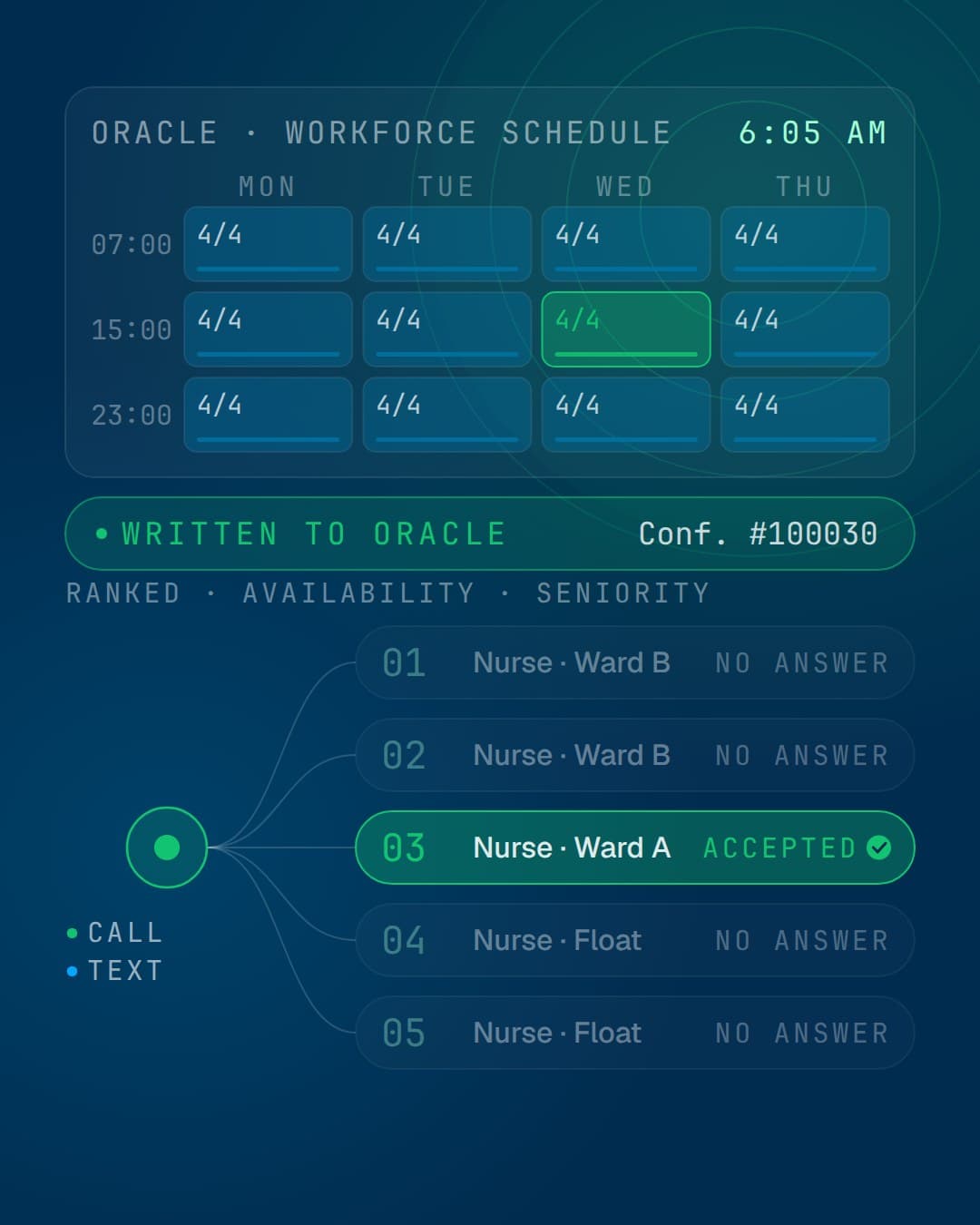
When someone calls in sick, the system finds the replacement — automatically. Payaptic Caller reads the open shift straight from Oracle, calls and texts eligible employees until one accepts, and writes the confirmed assignment back into the schedule.
The 6:05 AM problem
6:05 AM
at a school
A teacher calls in sick before first bell. Now the clock is running — and someone has to find a substitute, by hand.
It is the same story in hospitals, plants, warehouses, and call centres. The absence is only the start. The real cost is the scramble to cover it — and Payaptic Caller takes that scramble off your team’s plate.
Manual phone trees
A dispatcher works down a paper list, dialing potential replacements one at a time — before first bell, before the line opens, before the floor is short.
Time pressure, every single day
Every unanswered call delays coverage. Multiply that by hundreds of staff across dozens of sites and the morning is gone before it started.
Unfilled shifts have consequences
Uncovered classrooms, unopened buildings, understaffed floors, compliance exposure — and burned-out office staff left to chase it all.
Why it matters
Automated coverage, without the headaches.
Speed
Coverage in minutes, not mornings
Caller phones the first candidate and texts the next in line at the same time, then keeps moving down the list — so a shift is filled before the dispatcher would have finished dialing.
Simplicity
No phone trees, no spreadsheets
One automated flow replaces the paper call list. Rules for availability, qualifications, and seniority are built in, so nobody is working a list by hand at 6 AM.
Scale
Every site, every shift
Whether it is one location or hundreds of staff across dozens of sites, Caller runs the same reliable loop in parallel — coverage does not depend on who is in the office.
From sick call to confirmed coverage
How Payaptic Caller works
Absence logged
An employee calls in sick — by phone or in Oracle. The absence triggers Caller instantly.
List built
A ranked replacement list is assembled from availability, qualifications, and seniority rules.
Call + text
Caller phones the first person and texts the next in line, in parallel, to move faster.
Auto-escalate
No answer or a decline? It moves down the list until someone accepts.
Confirmed
Acceptance is recorded, the shift is assigned in Oracle, admins are notified — audit trail included.
Configurable rules: call windows, retry counts, union / seniority ordering, and escalation to a human if the list is exhausted.
See it work
Two sides of the same automated loop
The employee reports the absence by phone. The system finds and confirms the replacement — and writes it back into Oracle. Press play on either half below.
Demo · Automated call-out
The system fills the open shift
Caller reads the open shift straight from the Oracle workforce schedule, builds a ranked list of eligible employees, and phones them until someone accepts — then writes the confirmed assignment back into Oracle, automatically.
- Open shift detected in Oracle by a background process
- Accept, reject, or replay — captured with a confirmation number
- Shift assigned back into the Oracle schedule on acceptance
Demo · Absence call-in
An employee calls in sick
An employee calls the Payaptic Absence Reporting Line, is identified automatically, hears their upcoming schedule, and reports the right shift — choosing a full or half day and a reason — all through the automated service.
- Caller identifies the employee and reads back their schedule
- Full or half day, with a reason: sick, vacation, jury duty, and more
- Absence recorded with a confirmation number to keep on file
Demonstrated on Oracle HCM Cloud. Names, PINs, and confirmation numbers shown are from a test environment.
What’s in the box
Everything you need, included.
From the first sick call to the confirmed replacement in Oracle — the whole loop, out of the box.
Reads open shifts from Oracle
A background process watches the Oracle workforce schedule and triggers Caller the moment a shift opens up.
Ranked eligibility
Candidates are ordered by availability, qualifications, and seniority before a single call goes out.
Call + text in parallel
Phones the first person and texts the next, simultaneously, to fill faster.
Auto-escalation
No answer or a decline moves straight to the next name, until someone accepts.
Absence call-in line
Employees report absences through a guided phone line — full or half day, with a reason.
Confirmation numbers
Every acceptance and absence gets a reference number for the employee and the record.
Writes back to Oracle
Confirmed shifts are assigned in the Oracle schedule automatically — no re-keying.
Configurable rules
Call windows, retry counts, union and seniority ordering, and a human fallback if the list is exhausted.
Full audit trail
Who was called, who accepted, and when — recorded end to end, with admins notified.
In development — Coming soon
Get early access to Payaptic Caller
Payaptic Caller is a feature we are actively building. Tell us about your Oracle HCM environment and we will add you to the early access list — and show you a live walkthrough ahead of general availability.
What early access includes
A live demo against your call-out scenarios and a direct line to the team building it, so the release fits how your workforce actually schedules.